Festivals - Thanksgiving
Book / Produced by partner of TOW
"Consider what great things he has done for you" (1 Sam 12:24). There is a remarkable scene. near the beginning of the book Never Cry Wolf. The author is standing alone in the midst of the Alaskan wilderness as the plane that brought him fades into the distance. Overwhelmed by the rugged beauty, he finds a voice within him struggling to cry out for expression. "I wanted," he says, "I wanted to shout thanks to someone."
History
The first recorded celebration of Thanksgiving in North America was in Newfoundland in 1578. An English minister named Wolfall presided. There are records of another held in Maine in 1607. In December 1619 thirty-eight men landed safely on the banks of the James River near Jamestown in Virginia. The English captain, John Woodleaf, read a directive from his charter declaring that the day of their arrival "shall be yearly and perpetually kept as a day of thanksgiving to God."
It was the Pilgrims' settlement at Plymouth, Massachusetts, that is most often remembered as the site of the first Thanksgiving. Governor Bradford ordered a three-day celebration in October 1621. In keeping with the biblical instructions in Leviticus 23:39 for the Feast of the Ingathering, its purpose was to give prayerful thanks to God for the blessing of the harvest. The Christian commitment and spiritual motivation of this little group of people are inspiring.
Importance
The desire of an individual to offer thanks to God goes back to the early chapters of Genesis: "Noah found favor in the eyes of the Lord" (Gen 6:8 NASB). And God said, ''I will establish My covenant with you" (Gen 6:18 NASB). When Noah left the ark, having been saved by God, he "built an altar to the LORD. . .and offered burnt offerings on the altar. And the LORD smelled the soothing aroma" and promised, "While the earth remains, seedtime and harvest, cold and heat, summer and winter, and day and night shall not cease" (Gen 8:20-22 NASB). Noah modeled the importance of saying, "Thank you." And God blessed Noah and said,· "Be fruitful and multiply, and fill the earth . . . Every moving thing that is alive shall be food for you; I give all to you, as I gave the green plant" (Genesis 9:1, 3 NASB).
The experience of corporate thanksgiving finds expression in the annual harvest festival, that is, when Moses directed the people of Israel to observe a full week of thanksgiving after the ingathering of the harvest: ''When you have gathered in the crops of the land, you shall celebrate the feast of the LORD for seven days" (Lev 23:39 NASB). David and Solomon continued the tradition, declaring special times of celebration and thanksgiving to God. After years of captivity the great leader Nehemiah called the people together to thank God, thereby reinstituting the instructions from Leviticus regarding the harvest festival. It is recorded that there was great rejoicing (Neh 8:17).
There are at least 140 passages of Scripture that deal with the subject of thanksgiving from a
personal or corporate point of view. The word praise is used many more times. Praise means "to appreciate," "prize," and "consider worthy of honor." Thanksgiving is a combination of words joined to express thanks to God. It is gratefulness followed by expressions of that gratitude. By far the most familiar passages of praise are found in the Psalms: "With my mouth I will give thanks abundantly to the LORD" (Ps 109:30 NASB); "Give thanks to the Lord, call on His name; make known among the nations what he has done" (105:1); "Enter his gate with thanksgiving" (100·4).
In the New Testament we read how Jesus constantly gave thanks to the Father and one year risked his life to celebrate the thanksgiving festival. Paul began nearly every one of his letters with an expression of thanks and urged us to give thanks in everything (I Thess 5:18) . In Romans 1:21 he describes those under the judgment of God as people who "though they knew God, they did not honor Him as God, or give thanks" (NASB). The writer of Hebrews in 13:15 tells us to "continually offer to God a sacrifice of praise - the fruit of lips that confess his name."
Celebrating
The Bible tells us "rejoice always; pray without ceasing; in everything give thanks, for this is God's will for you in Christ Jesus (1 Thess 5 :16-18 NASB). There are many ways to give thanks; a number of ideas follow.
As a Hebrew proverb tells us, "Put something where you can see it so your eye will remind your heart."
Hang a cluster of Indian corn tied with an attractive bow on the front door. Remember the thankful spirit of the Pilgrims at Plymouth.
Lovingly assemble a harvest display with seasonal produce as your centerpiece.
Place a colorful leaf at each person's place at the holiday meal. On each leaf sprinkle several kernels of dried corn. Before the meal is served, take time to remember the hardships of the Pilgrims' first winter in the New World and how with God's help they overcame great difficulties. Take turns expressing your own gratitude for God's mercy.
Encourage children to make lists of all the things for which they are thankful.
Through a food bank or Christian agency, discover local needs. Decide together how you will help. This is the season to share with others.
The real celebration of Thanksgiving is thanksliving. The best way to thank God for the gift of life is to live your life in a spirit of gratitude.
Deuteronomy 8:10 says, "When you have eaten and are satisfied, you shall bless the LORD your God for the good land which He has given you" (NASB). The chapter warns that when everything is going well, there is a tendency for your heart to become proud and thus forget the Lord. Take time to thank God for all of the good gifts that you enjoy. Live out the words of Deuteronomy 8:18, "But you shall remember the LORD your God" (NASB).
» See also: Festivals—Christmas
» See also: Festivals—Easter
» See also: Nationalism
References and Resources
G. Gaither and S. Dobson, Let's Make a Memory (Waco, Tex.: Word. 1983) J. Santino, All Around the Year: Holidays and Celebrations in American Life (Urbana: University of Illinois Press, 1994); S. W. Shenk, Why Not Celebrate! (Intercourse, Penn.: Good Books, 1987); D. Steindl-Rast, Grateful: The Heart of Prayer (New York: Paulist, 1984); M. Zimmerman, Celebrate the Feasts (Minneapolis: Bethany House, 1981); M. Zimmerman, Celebrating the Christian Year (Minneapolis: Bethany House, 1993).
— Martha Zimmerman





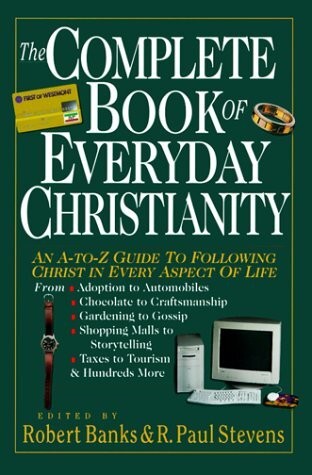
The authors Robert Banks and R. Paul Stevens have partnered with The Theology of Work Project to offer The Complete Book of Everyday Christianity in its entirety here. All rights reserved.
This resource was originally published in 1997, and the text has not been updated.