Public Spaces
Book / Produced by partner of TOW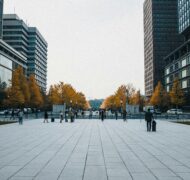
A public space is a space open to people’s informal and varied use. It is a space ready to be filled by whatever human content we give it. Public spaces come in many forms and are crucial to our building community in neighborhoods, towns and cities. The three most important types of public space are pavements (or sidewalks), parks (or playgrounds) and plazas (or squares). Why do we need such places? What makes some attractive to people and some not, and turns some into little-used or even unsafe areas? How should we use or reclaim these spaces?
Sidewalks and Pavements
In ancient times people made shorter trips on foot along gradually developed tracks or through cleared open spaces. As proper roads were built and vehicles increased, especially in and around cities, the amount and movement of traffic was regulated so that people could walk around safely or gather freely together. In ancient Rome, for example, commercial vehicles were able to enter the city only at night, after people’s daily rounds and public responsibilities were finished.
With the growth of the middle class and increase in horse-drawn carriages, and then the arrival of automobiles, walking and socializing were increasingly confined to sidewalks. But sometimes, as with boardwalks and promenades, these were quite expansive. In varying degrees all these enabled people to do errands and gather informally, children to play and observe life, and adults sometimes to sit and socialize on benches or in sidewalk cafés. In densely packed urban areas, with terraced houses and narrow streets, a large part of people’s social life occurred in such spaces. It was here that the sense and experience of a neighborhood were largely developed.
With the mass production of automobiles, traffic quickly increased in both amount and speed. As many streets were broadened to accommodate cars, sidewalks tended to narrow. In many new housing developments sidewalks do not exist at all, while private ownership of many lake- and beachfronts has prevented promenades and cliff walks from being built. Where crime has increased, large parts of inner-city areas have become unsafe at night and even during the day for some people. The density of traffic flow and creation of thoroughfares on many urban and suburban streets have seriously reduced or virtually destroyed contact between people who live along them, especially those who are on opposite sides of the road. Empirical studies can now predict how quickly this will happen and what defensive actions people will take. Overall there is an increasing tendency for the social life of both adults and children to move from the street to the backyard and from the steps (or porch) to the front rooms, and back rooms, of the house.
In her perceptive and prophetic account of American cities, Jane Jacobs speaks of sidewalks as being the heart of urban social life. They have, or should have, a more significant role than either parks or plazas. City life depends on how open sidewalks are to use and how widely they can be used by individuals and groups for spontaneous and organized, creative and routine, purposes. If sidewalks are to be really effective, housing along them should not be too far apart, the sidewalks themselves should be broad enough for children to play games and gather spontaneously, and traffic speed and flow should be regulated so that contact can be maintained across streets. Public activities, whether voluntary or official, should grow out of the informal public life of a street rather than be artificially organized. Safety should be a normal community function arising simply from more eyes looking at the street and more people using it. There is, therefore, less need for something as organized as a “neighborhood watch.”
If we are serious about renewing community in densely populated neighborhoods, then agitating for suitable sidewalks is actually more important than pressing for more parks and playgrounds, where there are generally fewer people present and less adult company or supervision. Of course, simply creating more space of this kind will not of itself alter much. It must be accompanied by other changes in people’s lifestyle—for example, spending more time around and outside apartments or small businesses, relying less on the automobile and exercise machines and more on walking, showing more interest in one’s neighbors and recognizing the multilayered value of common activities. In particular, at least one person on a street needs to emerge as a public character in frequent contact with a wide circle of people. This might be a local neighborhood-watch organizer (a modern version of the town crier), a people person or a street pastor. There is a wonderful vocation here for Christians in particular.
Urban planners, architects and developers involved in creating new urban spaces should give more thought to what made older neighborhoods more sociable and safer places in which to live, as well as to a proper mix of public, commercial, social and private spaces. This should also be part of building new or renovating old suburbs, for thinning out residences tends to lead to less, not more, community and to more, not less, danger. More attention should also be given to the pattern and use of streets, replacing the blocklike grid with one developed more like the spokes on a wheel. In all these ways there is a strong vocational contribution to be made by such people.
Parks and Playgrounds
Parks have a long history. The description of the Garden of Eden in Genesis 2 is reminiscent of a park, and in ancient times many imperial capitals had parklike areas. A well-known example is the Hanging Gardens of Babylon. A central feature of medieval towns and villages, especially in England, was the commons, a piece of undeveloped public land that could be used for socializing, grazing or festivals. From the time of the Enlightenment, parks began to take on a more ordered shape. In line with the basic position given to mathematics and the new emphasis on human order and control, the planning of parks gained in importance. New kinds of parks came into existence, such as botanical gardens, though the Romantic movement later gave impetus to more natural arrangements. Through the influence of figures such as Frederick Remington in the mid-nineteenth century, a movement grew in North America to preserve and develop public spaces into parks on a wide scale. Later still more specialized playgrounds came into being, sometimes based within parks, sometimes separate from them.
Today parks and playgrounds can be found in most places where people live, including suburbs and even smaller rural settlements. Some are extremely large and carefully developed, such as Central Park in New York City, offering multifarious uses. Others, such as Griffith Park in Los Angeles, contain an interesting mixture of planned and relatively natural space. Parks attract people who want to relax or meditate, socialize and eat with others, exercise or play games, hold communal events or public celebrations.
Unfortunately in some locations parks have also become places where people may be mugged or attacked, where drugs are readily available and used, where street people sleep and even reside, and where gangs gather or mark out turf. In other locations parks have become largely empty, being used only occasionally by the people around them. There are various reasons why parks meet these unfortunate fates: (1) people are too busy with work and other leisure activities to use parks regularly; (2) the community has broken down, resulting in inadequate neighborhood supervision of parks and children’s playgrounds; (3) some parks and playgrounds are inconveniently sited or designed in ways that are not user-friendly; (4) the community’s unemployed or marginal residents lack job opportunities or available space where they can gather; (5) gangs and street people sometimes claim and fight over such public territory.
Since parks are the breathing places of the city, opening them up more for public use requires a range of strategies. Individual Christians, churches and other religious organizations can make a significant contribution to these. Those who live within range of a park can find ways—as individuals, families, friends, neighbors, home churches and congregations—to make regular use of it for any or all of the purposes mentioned. Those who work near city parks and who use lunch breaks to work or shop rather than relax, meditate, socialize or play could spend more time in parks for any of these purposes, overcoming the proven resistance people have to walking to any place that is more than two hundred yards away. And, where necessary, neighborhood watches could expand their responsibilities to protect parks and playgrounds in the vicinity from antisocial or criminal behavior.
There are other actions that can be taken. Congregations that have a reasonably sized property could turn some of the space into a small park or playground for the use of nearby residents. Congregations and residents could also put pressure on city officials to upgrade and multiply facilities in parks so that they can have the widest range of uses. Urban planners and developers could do more to site playgrounds and parks where it is easiest for people to gather and to construct them in such a way that they are inviting and safe. (It is seldom recognized, for example, that the amount of public use of a park depends to a large extent on whether people can see easily into it. That is, if a park is more than four or five steps up from the pavement or is ringed by hedges or non-see-through fences, its use decreases exponentially.)
Plazas and Squares
A plaza is a form of public space that has a long and respected history. Though it predates western European civilization, it is best known to us through many fine examples in Mediterranean countries, especially in Spain and Italy. The Spanish word plaza means simply “place,” and the related Italian term piazza means “broad way” or “street.” Originally these were not planned: the typical broad, open square developed organically out of the need for large-scale public marketplaces. Probably the best known and admired example today is the Piazza San Marco in Venice. From the Renaissance onward, planning of such spaces became more common, with special attention being paid to the visual and architectural, more than commercial and social, aspect. In English-speaking cultures, the term square was more commonly used.
Outside western Europe, cultures affected by Spanish influence built cities containing fine plazas, and there were imitations elsewhere. With the advent of the car, many plazas and squares were broken up by roads. The generously sized King’s Square in Copenhagen, for example, was divided into forty-eight pedestrian islands separated by roads. Over the last two or three decades, there has been a move to close densely used roads in the center of some cities and allow only pedestrian or service traffic. In some places this leads to a re-creation of the pedestrian mall, but where there are broad roads or boulevards, there is a partial restoration of the plaza. Here and there older plazas and squares have been returned to their original condition.
The advantages of the classical plaza or square were many. It invited people to gather in large numbers, not only for the purposes of buying and selling but also for the purpose of socializing more generally. The classical plaza generated what the urban designer Jan Geyl calls “life between buildings” as compared to life squeezed out by buildings (or roads). The plaza was large enough, and the activities within it comprehensive enough, to represent some sense of the whole city. Surrounded as it was by many of the city’s most important buildings, which were also built on a scale that did not dwarf their inhabitants, the plaza gave people a feeling for the unity of the city.
In any town of reasonable size, there is a great need for such public spaces. Since they provide a meeting place for all interested citizens, they are a kind of public living room where people can gather in large or small groups, socialize, advocate various causes, buy and sell, refresh themselves, engage in civic and political activities, dance and hold festivals. The plazas or squares need to be an appropriate size for the city or town of which they are a part. They should also contain plenty of places to sit, whether publicly provided benches or seats in open-air cafés, and seating needs to be flexible, facing onto the square as well as around tables.
In recent times the word plaza has been appropriated by shopping centers, but these are restricted spaces compared with the free and varied uses people can make of genuine plazas. Shopping malls are private, not public, spaces, whose activities are controlled by their owners, not by the people in general. The siting of such centers on the edge of suburbs or cities also fragments the population, making it more difficult to reinvent the plaza in any effective way.
But wherever public plazas and squares exist, we should seek to enjoy them and invite others to them. As well as using them for a range of informal purposes, groups and congregations should look for ways to develop appropriate pockets of activity around the edges of the square. These could be artistic, dramatic or evangelistic in character and should spring from a desire to “seek the welfare of the city” (Jeremiah 29:7 NRSV), not merely use it as a means to our own ends.
Conclusion
In general, what turns available public spaces into interactive public places is a shift in the public attitude toward life; that is, life is as much about being and relating as about doing and achieving. Once life is viewed in this way, communities can provide places that are conducive to our becoming aware of other people and being addressed by them, to the opportunity to engage in play and in spontaneous or informal celebrations, to ease of interaction with the natural or humanly created environment, to the presence of a sense of adventure, mystery or new possibilities, to an ethos that connects us with the past and therefore helps shape identity and multiple lines of connection to lived reality.
» See also: Architecture, Urban
» See also: Community
» See also: Shopping Malls
References and Resources
C. Alexander, S. Ishikawa and M. Silverstein, A Pattern Language: Towns, Buildings, Construction (New York: Oxford University Press, 1977); D. Engwicht, Reclaiming Our Cities and Towns: Better Living with Less Traffic (Philadelphia: New Society, 1993); J. Geyl, Life Between Buildings: Using Public Space (New York: Van Nostrand Reinhold, 1987); J. Jacobs, The Death and Life of Great American Cities (New York: Vintage Books, 1961).
—Robert Banks





The authors Robert Banks and R. Paul Stevens have partnered with The Theology of Work Project to offer The Complete Book of Everyday Christianity in its entirety here. All rights reserved.
This resource was originally published in 1997, and the text has not been updated.