Weddings
Book / Produced by partner of TOW
Although the number of weddings taking place in church buildings has declined over the last few decades, the traditional paraphernalia of weddings has diminished very little, and the amount of time and money spent on them has only increased. The wedding day, and all that goes with it, is often the major preoccupation for couples who wish to marry, churchgoers as well as others. A huge industry has grown up around it, providing invitations and cards, wedding rings and flowers, dresses and suits, wedding presents, flowers and bouquets, marriage celebrants and witnesses, reception places and services, food and music, and travel arrangements for the honeymoon. Not only wealthier but sometimes poorer families, especially ethnic and working-class ones, often spend large amounts of money to cover wedding expenses.
Most pastors ensure that couples getting married have some instruction and counseling to prepare for their life together. They also insist that wedding services themselves contain Christian instruction. But there is remarkably little Christian reflection on our current preoccupation with weddings, the forms they take or even the money spent on them. Consequently, weddings involving Christians may have a certain spirit or content which other weddings lack, but in most other respects they do not seem to be very different from other weddings. Here, as in so many other areas of life, we take our cues as much if not more from the culture around us than from basic Christian principles.
Weddings Down Through the Centuries
Formal celebrations to mark the beginning of a marriage exist in every society. As far back as records go, they form an important rite of passage formalizing both the relationship of male and female and the family as an institution. But it is difficult to trace the origin of wedding celebrations themselves. We can, however, note the appearance of certain marriage ceremonies. The Kiddish Jewish ceremony was present by the fourth century b.c., and the Christian wedding ritual of separating the betrothal from the nuptial service had formed by the ninth century.
We also can trace the origins of some specific elements or customs. The giving of consent, including that of the head of the household, goes back to Roman times. Wedding bands or rings, whose circular forms now express the eternal nature of love, developed out of ancient tribal customs in which women wore grass bracelets around their wrists or ankles. The placement of the ring on the third finger of the left hand has its source in ancient beliefs concerning the direct connection between that particular finger and the heart. Using white for bridal gowns is a Greek custom stemming from the association between that color and purity or joyfulness. Other features, such as wearing a veil to symbolize purity or throwing rice to wish people the blessing of many children, are also long-standing traditions. From the Romans came the custom of eating a cake, which was originally offered to Jupiter.
Throughout the whole biblical period and well into the Middle Ages, weddings were arranged by the families concerned without any reference to professional religious people, such as priests, or to any official institutions. They were public and binding affairs, sometimes involving whole villages, but did not have the formal civic or legal status that marriages have today. That is why some Pharisees were able to divorce their wives on the slightest of grounds just by drawing up a document to indicate their desire to be divorced (Matthew 19:3-7). In the first millennium after Christ weddings continued to be arranged in much the same way. It was only to overcome certain abuses that during the Middle Ages priests were drawn into weddings, and later still that church legislation was passed requiring people to marry in a church building.
The earliest portrayals we have of marriages in the Bible provide little in the way of specific detail about wedding ceremonies. While some have tried to find the trace of an ancient liturgical blessing in God’s words to the first couple to “be fruitful and multiply” (Genesis 1:27-28 RSV), this is only a supposition. We do know a few concrete things about biblical weddings. Prior to the wedding came the betrothal; from that time on a couple was regarded as married, not simply engaged. This involved the negotiation of a dowry. For the wedding itself the bride wore a veil and wedding dress. When the Bible mentions wedding finery of rings, jewels and ornaments, this likely refers to marriages of wealthy families. The groom set out for the bride’s house, at which her father pronounced a blessing. Then a procession of friends and neighbors came to the bridegroom’s house, and they celebrated with a feast that could last up to a week or more (Judges 14:12). It was this procession that was the actual wedding ceremony. Though not too much weight should be placed on it, the first time marriage is referred to specifically as a covenant occurs in the last book of the Old Testament (Malachi 2:14). A marriage license is mentioned for the first time only in the later inter-testamental book of Tobit.
A similar pattern for weddings lies behind several New Testament accounts. In passages like Matthew 25:1-12 their festive character (with loud acclamations), the scale on which they could be celebrated (ten attendants) and the flexible time frame for the occasion (no one is quite sure when the ceremonies will begin) also come through. As is often the case with proposals of marriage today, the date of weddings at this time appears to have been set by the groom and his family, and sometimes came as a surprise to the bride and her maids. Later Jewish writings, such as the Mishnah and the Talmud, prescribed other elements that might reflect earlier practice, such as the father’s giving away of the bride. This was probably based on daughters’ being the property of their father.
A Christian Perspective on Weddings
Developing a more thoughtful Christian perspective on weddings is not primarily a matter of separating out features that have pagan origins and discarding them in favor of others that stem from earlier Christian practice. Throughout history believers have taken up many things from their surrounding culture and then processed and woven them into meaningful Christian use. In any case, Christians themselves are as capable as anyone else of initiating practices that have a sub-Christian content or significance. But neither should we try to isolate elements of weddings that have some biblical parallel. The Bible was never intended to be a manual for wedding services, and the stories it contains about weddings reflect many agrarian Middle Eastern customs that would be artificial today. Instead, we need to reflect on the character and significance of the form weddings take today in light of a range of wider biblical principles and theological perspectives.
Here are a few guidelines we might consider.
While the wedding day and ceremony is one of the highlights of a person’s life, we should not attribute so much importance to it that it takes away from more fundamental things. Sometimes planning for a wedding takes up so much time and energy that couples put their relationship on hold while they go into business mode or, worse, find that this puts pressure on their relationship and causes serious tensions between them. It is sad when couples miss out on the benefits and pleasures of their engagement because organizing the wedding takes up most of their time and energy. While dealing with the complex and sensitive issues associated with planning a wedding can help a couple mature in their relationship, there is a point where the whole process becomes counterproductive. Sensitivity and common sense are required here.
While it is important that the wedding day go well, we must not give in to the temptations of perfectionism and professionalism. Perfectionism is the tendency to want every single aspect, every single item and every single person associated with the wedding to be “just so,” without any blemish. Working toward this can be anxiety-producing and fatiguing—indeed exhausting for all concerned—and can take much of the pleasure and enjoyment away from the occasion. Professionalism is nearly as bad. Increasingly couples hand over the planning and running of weddings to people who create an atmosphere that detracts from their essential family or friendly nature. Such people may be more polished and wittier, but often they make it more difficult for others to feel comfortable when it is their turn to contribute. If participants make a mistake, they feel they have committed a cardinal sin and let the whole wedding down. Too professional an atmosphere also tends to work against people relating to one another in a natural way. Instead, everyone begins to feel under pressure to perform.
While everyone wants a beautiful and memorable wedding, Christians have good reason to be concerned about the expense involved in even a moderately priced wedding in our culture. In North America it is not uncommon for people to spend $20,000 or more for a wedding and all the festivities before and after. Though we should not approach important occasions for celebrating with a miserly attitude, we do need to consider the biblical principle of simplicity (see Simpler Lifestyle). This applies to wedding showers as well. If in our culture at large there is a tendency to spend too much on externals and to fall prey too easily to the seductions of luxury, we should take care that even our celebrations bear witness to a different set of values. An important part of our vocation as Christians today is to show that it is possible to have a good time without spending too much (see Partying). There are other factors too. The excessive amount of money spent on some weddings, or honeymoons, could if redirected actually give a young couple a more secure financial start in life by helping them put down a deposit on a house or apartment.
While we tend to think of weddings as separate from corporate worship, inviting our church family to actively participate in this God-honoring event is a way of worshiping together. Once upon a time weddings used to take place in the ordinary context of corporate worship. Everyone would know about this in advance, and special guests would come from some distance. But weddings were an integral part of the ongoing communal life of a couple’s, or at least one of the couple’s, wider Christian family. The separation between these two that now takes place involves significant loss if also some gain. We are not proposing that all weddings between believers should take place in a normal corporate worship setting, but we should give careful thought as to how much of this can be preserved. One way of doing this today would be to place some of the responsibility for organizing and leading the wedding in the hands of the primary small group or house church (see Church in the Home) where they are best known. Single friends should also be drawn into helping so that they do not feel too left out of the relationship. In some cases the reception (or even the wedding itself) could take place outside one of their homes, or in some place closely associated with the life of the group.
While we are often told that the day belongs to the bride, the wedding ought to concentrate equally on the bride and the groom. There is no room in a Christian wedding for intentions or expressions based on the view that “this is the bride’s day.” Marriage is a genuine partnership, and this should be clearly symbolized from the beginning. This means as well that the couple could help create the service which will unite them, making it a very personal reflection of themselves. They need not discard, of course, all the long-standing traditions associated with weddings—many are long-standing because they have proven their value—but even these can be given creative or contemporary touches. Some changes should certainly be introduced, such as removal of the word obey from the wife’s vow (or its introduction into the husband’s as well) and presentation of the bride and groom by both sets of parents, instead of the father giving the bride away.
» See also: Festivals—Christmas
» See also: Festivals—Easter
» See also: Festivals—Thanksgiving
» See also: Marriage
» See also: Partying
References and Resources
A. C. Cardozo, Jewish Family Celebrations (New York: St. Martin’s Press, 1982); J. P. Dever, “Marriage,” The New International Dictionary of the Christian Church (Grand Rapids: Zondervan, 1974) 633-35; A. Fisher, “The Jewish Liturgy of Marriage,” in The Jewish Roots of Christian Liturgy, ed. Eugene J. Fisher (New York: Paulist, 1990); D. Glusker and P. Misner, Words for Your Wedding (New York: Harper & Row, 1983); P. Lacey, The Wedding (New York: Grosset and Dunlap, 1969); D. Moore, The Wedding Guide (Seattle: IMS/Wedding Guide, 1993); J. M. Egan and M. Burbach, “Matrimony,” New Catholic Encyclopedia, vol. 9 (New York: McGraw-Hill, 1967); K. Stevenson, Nuptial Blessing: A Study of Christian Marriage Rites (Nashville: Thomas Nelson, 1983).
—Robert and Julie Banks





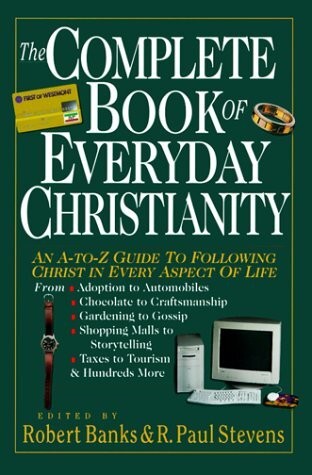
The authors Robert Banks and R. Paul Stevens have partnered with The Theology of Work Project to offer The Complete Book of Everyday Christianity in its entirety here. All rights reserved.
This resource was originally published in 1997, and the text has not been updated.